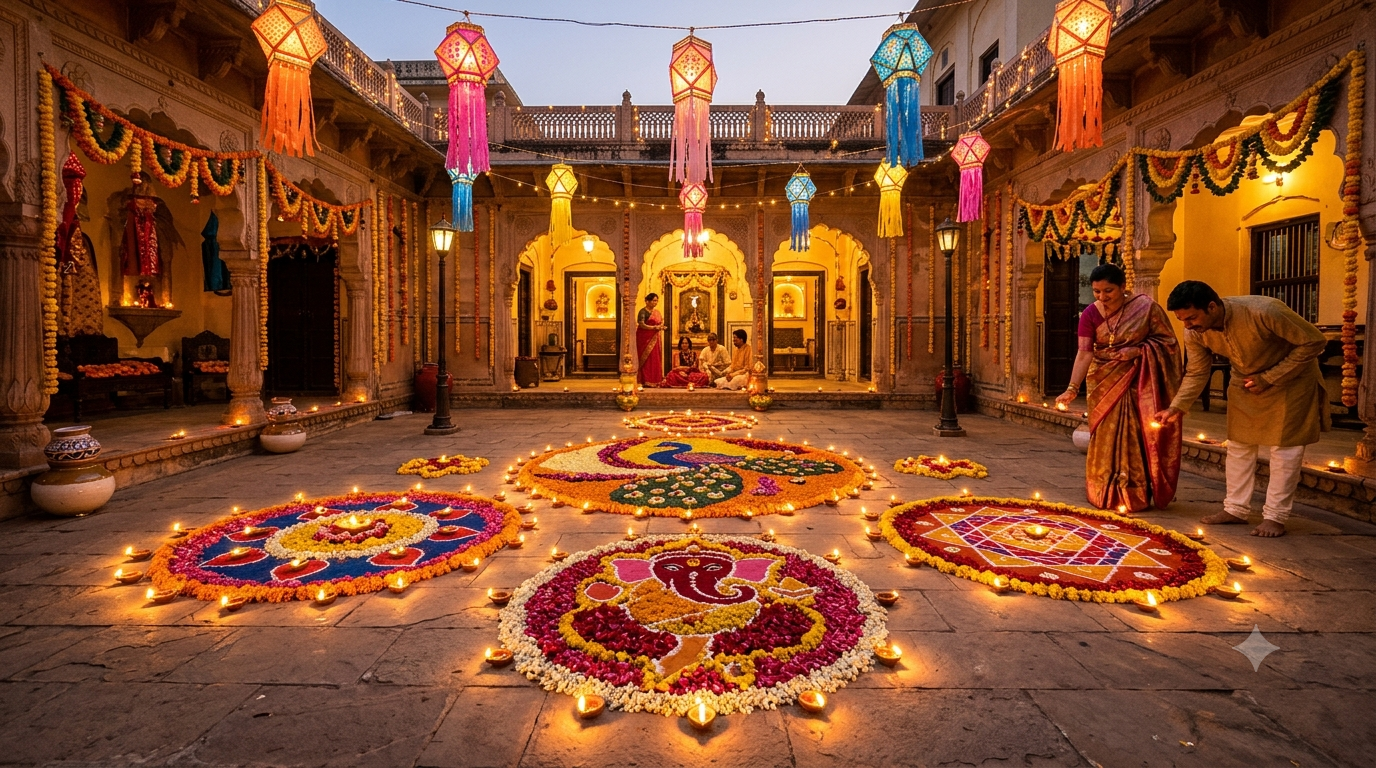
Long before the first firecracker goes off, Diwali announces itself at the doorstep. A freshly drawn rangoli glows with colour, and a lantern sways above it, throwing warm light on the floor. Over the years of travelling across India, I’ve noticed that these two simple traditions change character every few hundred kilometres. A doorstep in Tamil Nadu looks nothing like one in Bengal or Maharashtra, and that variety is what this post is about.
Why Rangoli? The Meaning Behind the Colours
Rangoli, from the Sanskrit rangavalli (“rows of colour”), is drawn at the entrance of the home to welcome guests and, according to tradition, Goddess Lakshmi. During Diwali it is believed to invite prosperity and good fortune. Many families draw it fresh each day of the festival.
Traditional materials include:
- Rice flour, which feeds ants and birds, so the art is also an act of generosity
- Coloured powders, made from turmeric, kumkum and other natural pigments
- Flower petals, usually marigold and rose
- Diyas, set at the centre or along the edges
Rangoli Across India: A Regional Tour
Kolam (Tamil Nadu): White rice-flour patterns built from a grid of dots, often drawn daily at dawn. The lines loop without a break, and are said to keep evil out.
Muggu (Andhra Pradesh and Telangana): Similar in spirit to kolam, but often larger and more elaborate on festival days.
Rangavalli (Karnataka): Free-hand and dotted designs, frequently with flower and lotus motifs.
Alpana (West Bengal): Painted rather than sprinkled, using a wet rice-paste on the floor. Its flowing lotus and footprint motifs are linked to Lakshmi’s arrival.
Aipan (Uttarakhand): Red earth (geru) is the base, and designs are drawn with rice paste. It is a striking, graphic style.
Sanjhi (Mathura-Vrindavan region): Intricate designs with cut-out stencils, with roots in Krishna devotion.
Maharashtra and Gujarat: Bold, colourful powder rangoli, often with peacocks, lotuses and swastikas, filling entire courtyards.
Lanterns: Lighting the Way Home
If rangoli is the welcome on the ground, lanterns do the same overhead. Diwali celebrates light over darkness, and hanging lanterns carry that idea skyward.
Akash kandil (Maharashtra): The traditional star-shaped paper or bamboo lantern, hung outside homes from the start of the festive season. Its name means “lamp of the sky”.
Paper and cloth lanterns: Lightweight, colourful and easy to make at home, they are popular across North India.
Brass and metal lanterns: Perforated designs cast patterned shadows, and they last for generations.
Modern twists: LED fairy-light lanterns, fabric versions and upcycled jar lanterns give you the look with less fire risk.
Try It Yourself: Simple Ideas for Your Home
A beginner rangoli
- Sweep and dampen the floor so the colour holds.
- Start with a simple dot grid or a circle of chalk.
- Fill the outline with colour, working from the centre outward.
- Finish with petals and a diya.
A paper lantern in a few steps
- Fold a sheet of coloured paper in half lengthwise.
- Cut slits from the fold almost to the edge, leaving a margin.
- Unfold, roll into a cylinder, and glue the short edges.
- Add a handle strip and hang with a battery tea light inside.
Eco-friendly tips: Use rice flour, flower petals and natural colours instead of synthetic powders, and choose reusable LED lights over single-use decorations.
Where to See the Best Diwali Decor
North India
- Delhi: Chandni Chowk and Sadar Bazaar overflow with lanterns, diyas and fairy lights in the days before Diwali.
- Jaipur, Rajasthan: Johari and Bapu Bazaar are strung with lights, and homes are decorated with mandana, a traditional floor and wall art.
- Amritsar, Punjab: The Golden Temple glows with lamps for Bandi Chhor Divas, which falls on Diwali.
- Ayodhya, Uttar Pradesh: The Deepotsav celebrations light up the ghats of the Saryu with lakhs of diyas.
- Varanasi, Uttar Pradesh: The ghats are lined with diyas, though the biggest display is Dev Deepawali, held a couple of weeks after Diwali.
- Mathura-Vrindavan, Uttar Pradesh: Home of the intricate sanjhi art.
- Kumaon, Uttarakhand: Look for aipan, drawn in red earth and rice paste.
West India
- Mumbai, Maharashtra: Markets such as Dadar sell akash kandil in every size, and buildings hang them from balconies.
- Pune, Maharashtra: Tulshibaug is a good stop for festive shopping.
- Ahmedabad, Gujarat: Bold courtyard rangoli, and the Gujarati New Year the day after Diwali adds another round of decoration.
- Goa: Giant Narakasura effigies are paraded and burnt on the eve of Diwali, and homes hang colourful lanterns.
South India
- Tamil Nadu: Kolam at dawn on doorsteps, especially in Madurai and Chennai’s older neighbourhoods. Deepavali is marked here with an early-morning oil bath and sweets.
- Karnataka: Rangavalli and lamps in Mysuru and Bengaluru’s old quarters.
- Telangana and Andhra Pradesh: Muggu designs in Hyderabad and across the Telugu states.
- Puducherry: A mix of French-quarter charm and Tamil kolam traditions.
East India
- Kolkata, West Bengal: Diwali here is Kali Puja night, with alpana, elaborate pandals and rows of candles and earthen lamps.
- Odisha: The Badabadua Daka ritual honours ancestors with lamps, and the Kali Puja pandals in Cuttack are worth a visit.
- Jharkhand: Sohrai wall paintings, made around harvest and Diwali time, are a lovely folk art to look for in village houses.
- Bihar: Earthen diyas and rangoli in Patna and surrounding towns.
Central India
- Madhya Pradesh: Ujjain and Indore light up with diyas and rangoli, and the Malwa region has its own mandana style.
- Chhattisgarh: Rural homes decorate with traditional wall and floor patterns during the festive days.
Rangoli and lanterns are small acts, but they make a home feel like it is waiting for someone. Whether you draw a simple flower or hang a handmade lantern, you’re joining a tradition that has been renewed every autumn for centuries. Wishing you and your family a bright, colourful Diwali.
Which rangoli or lantern style is your favourite? Tell me in the comments, and share a photo of yours!

